Physical Address
304 North Cardinal St.
Dorchester Center, MA 02124
Physical Address
304 North Cardinal St.
Dorchester Center, MA 02124
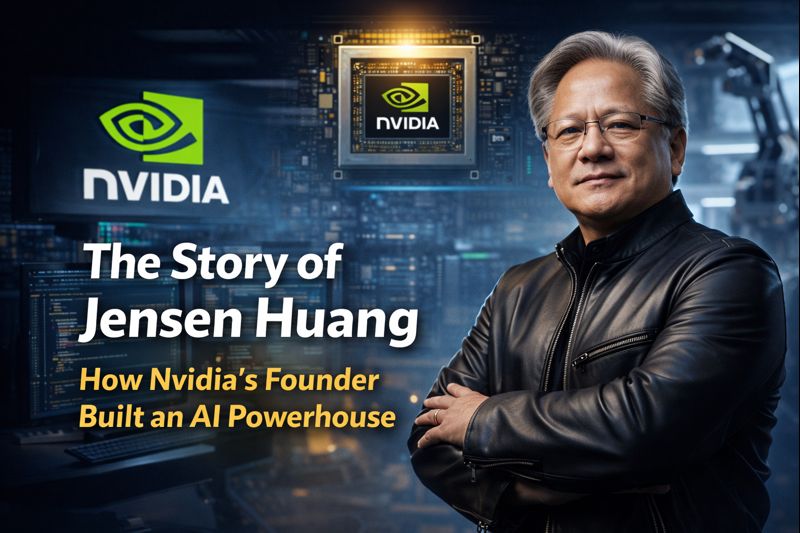
If you have followed developments in artificial intelligence over the past decade, one name appears again and again: Nvidia. The Santa Clara based semiconductor company has become the backbone of the global AI revolution, supplying the high-performance graphics processing units (GPUs) that power everything from generative AI models to data centers and autonomous systems.
At the center of this transformation stands Jensen Huang, Nvidia’s co-founder, president, and CEO. His long-term vision, relentless execution, and deep belief in accelerated computing have not only turned Nvidia into one of the most valuable companies in the world but have also made Huang one of the most influential leaders in modern technology.
By 2024, Jensen Huang entered Forbes’ list of the world’s ten richest people, reflecting Nvidia’s extraordinary rise during the AI boom. But this success was decades in the making.
Jensen Huang was born in Taiwan in 1963. His early childhood was split between Taiwan and Thailand, giving him exposure to different cultures at a young age. Later, his parents sent him and his brother to the United States, where they lived with relatives in Tacoma, Washington.
Huang attended Oneida Baptist Institute in Kentucky, a strict boarding school that helped shape his discipline and resilience. After his parents permanently immigrated to the U.S., the family settled in Oregon. Huang completed high school at just 16 years old, demonstrating academic maturity early on.
He went on to earn a bachelor’s degree in electrical engineering from Oregon State University, followed by a master’s degree in electrical engineering from Stanford University a combination that laid the technical foundation for his future career in semiconductors.
Before becoming a tech executive, Huang learned the value of hard work through humble jobs. As a teenager, he spent summers working at a Denny’s restaurant in Portland, washing dishes, bussing tables, and serving customers. He has often cited this experience as an early lesson in discipline, teamwork, and perseverance.
Professionally, Huang began his engineering career at Advanced Micro Devices (AMD) in the mid-1980s, followed by a longer stint at LSI Logic, where he worked on chip design and semiconductor manufacturing. These roles gave him deep insight into the limitations and future potential of computing hardware.
In 1993, Jensen Huang co-founded Nvidia alongside Curtis Priem and Chris Malachowsky. The company’s origin story is famously modest the idea for Nvidia was discussed at a Denny’s restaurant in Northern California, not in a glamorous Silicon Valley lab.
At the time, Nvidia focused on graphics acceleration, a niche market largely centered on gaming. The breakthrough came in 1999 with the launch of the GeForce 256, marketed as the world’s first graphics processing unit (GPU). This product fundamentally changed computer graphics and laid the groundwork for parallel computing.
What few realized then was that GPUs would eventually become essential for artificial intelligence, due to their ability to process massive amounts of data simultaneously.
As machine learning and deep learning gained traction, Nvidia’s GPUs emerged as the ideal hardware for training AI models. Under Huang’s leadership, the company pivoted decisively toward accelerated computing, investing heavily in software ecosystems like CUDA, which made Nvidia hardware indispensable for developers.
By the early 2020s, Nvidia had become the dominant supplier of AI chips to:
In 2023, Nvidia joined the exclusive trillion-dollar market capitalization club. Just two years later, during the height of the AI boom, the company reached a historic $5 trillion valuation, making it the most valuable technology company in the world at the time.
Jensen Huang is widely known for a leadership style that blends intensity, transparency, and deep involvement.
Key traits of his management approach include:
Former employees often describe him as demanding but highly focused, with an exceptional attention to detail. Huang believes that speed, clarity, and accountability are critical in fast-moving technology markets.
His personal commitment to Nvidia is also symbolic. He famously has Nvidia’s logo tattooed on his shoulder, a promise he once made if the company’s stock crossed a major milestone. His signature black leather jacket, worn at product launches and keynote events, has become an iconic part of Silicon Valley culture.
Huang met his wife, Lori, while studying at Oregon State University. The couple has two children, both of whom work at Nvidia:
An interesting footnote in tech history is that Jensen Huang is a distant cousin of Lisa Su, the CEO of AMD one of Nvidia’s largest competitors in the semiconductor industry.
Huang lives in Silicon Valley, close to Nvidia’s headquarters in Santa Clara, California.
Over the years, Jensen Huang has received numerous honors for his contributions to technology and leadership, including:
As of mid-2025, Huang owned approximately 3.77% of Nvidia’s outstanding shares, making him the company’s largest individual shareholder. His net worth has been estimated at over $165 billion, reflecting Nvidia’s unprecedented growth.
Despite Nvidia’s dominance, Huang has been candid about the pressures that come with leading the AI industry. The company faces:
In one internal meeting, Huang famously remarked that strong performance could paradoxically increase fears of an AI bubble highlighting the delicate balance Nvidia must maintain.
Jensen Huang continues to lead Nvidia with the same long-term mindset that defined its early years. His ability to anticipate technological shifts particularly the rise of AI has positioned Nvidia at the center of global innovation.
Regardless of future market cycles, Huang’s impact on computing, artificial intelligence, and the semiconductor industry is already historic. Nvidia’s technology now underpins much of the modern digital world, and its influence will likely continue for decades to come.






[…] You are not penalized.You are not blocked.You are simply unproven. […]